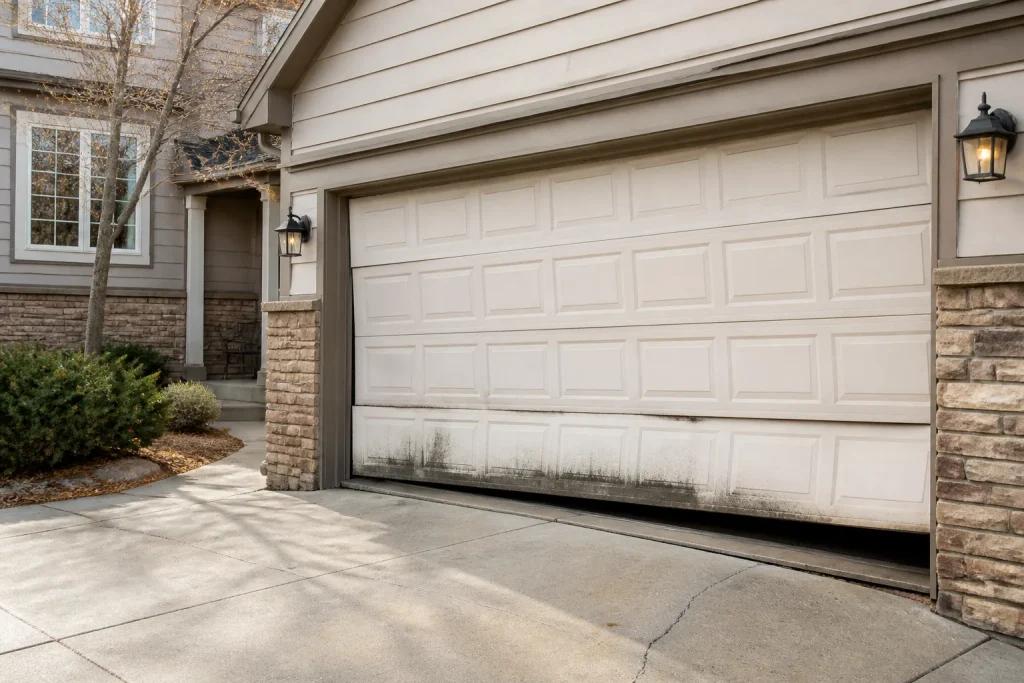
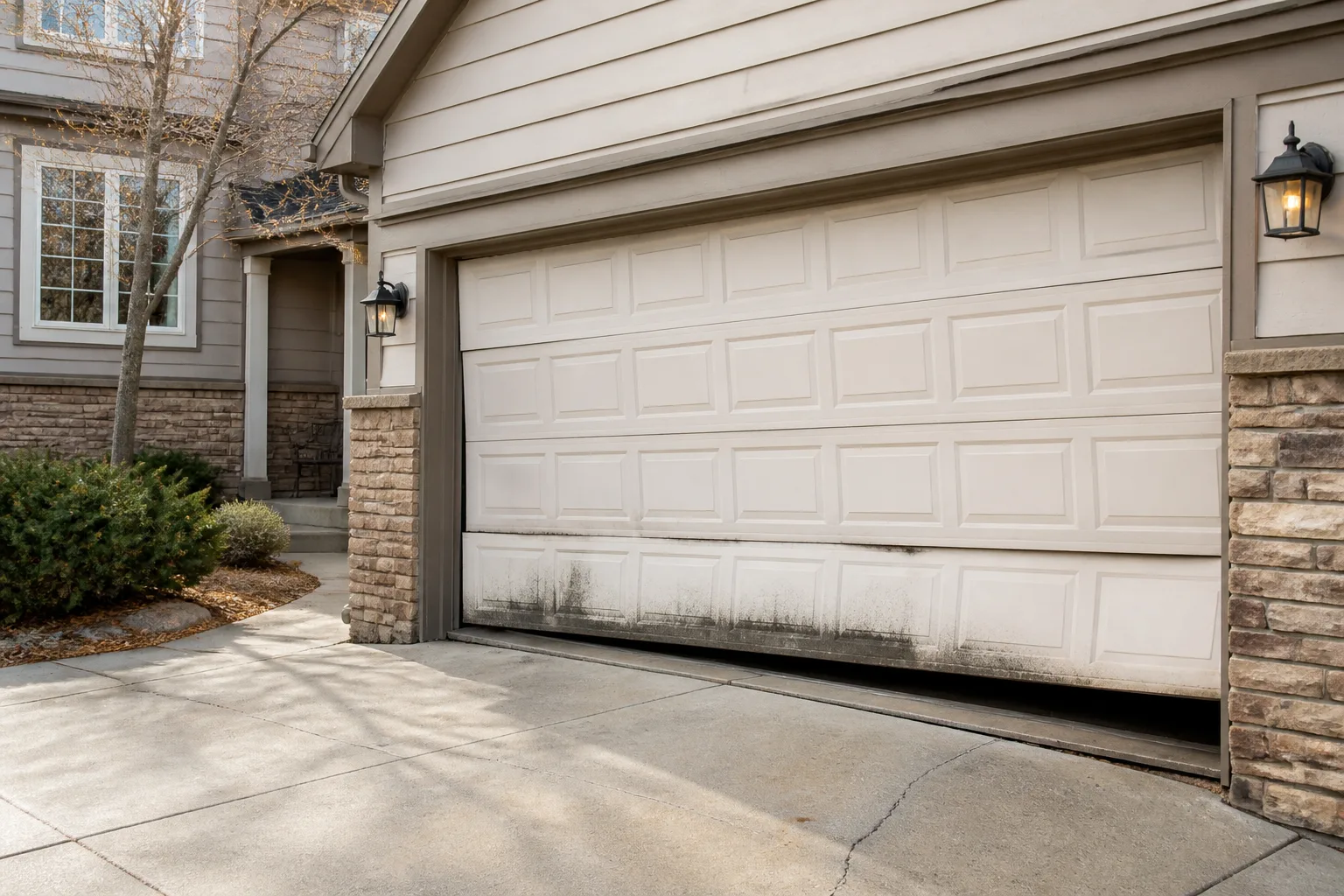
Top Signs You Need Garage Door Service – Don’t Ignore These
Your garage door is the largest moving mechanical object in your house, and it cycles around 1,500 times a year. The trouble is, most homeowners wait until it won’t move at all before they call anyone. The signs are usually there first, and in Highlands Ranch they tend to follow the seasons. A grinding noise that shows up in January is a different problem than the same grinding in July. Read the door by when it started acting up, not just how. If you’d rather not guess, call (877) 331-7827.
Why the Timing of a Symptom Matters More Than the Symptom
Most garage door advice hands you a flat checklist: grinding, squeaking, slow, crooked. That’s fine as far as it goes, but it skips the part that actually tells you what’s wrong. Colorado’s temperature swings stress specific components on a schedule. Winters tighten and snap springs and shrink the metal in your tracks; summers cook openers and warp panels in the afternoon sun. So the calendar is your first diagnostic clue.
Here’s roughly how the year breaks down in our experience around Highlands Ranch:
- Winter (spring snaps, frozen tracks): Cold contracts the steel torsion spring, and a spring already near the end of its life is most likely to break on the first hard freeze. Tracks can ice up or bind when temperature drops fast, and a door that only sticks on cold mornings is telling you something.
- Summer (opener overheating, warped panels): A motor working harder than it should will overheat and shut itself down, then come back after it cools. Panels and seals take a beating in sustained heat too.
- Spring and fall (the in-between failures): This is when the slow stuff surfaces: a motor that’s been laboring all year, a roller that’s worn flat, a cable that’s been quietly fraying.
Same noise, different month, different part. That’s why “what does it sound like” and “when did it start” are the two questions we ask first on any Garage Door Repair Highlands Ranch call.
The One-Minute Balance Test (Do This Twice a Year)
Here’s the single most useful thing you can check in Highlands Ranch, and almost nobody does it. It takes a minute and it tells you whether your door is fighting its own opener.
The balance test: with the door closed, pull the manual release so the door disconnects from the opener. Lift it by hand to about halfway, then let go. A healthy door stays roughly where you leave it. A door that slams down or drifts up is out of balance, meaning the springs are no longer carrying the door’s weight, and the opener motor is now doing the lifting.
An unbalanced door is expensive in a way you don’t see on the invoice right away. The opener motor runs hot, wears faster, and shortens its life. You may get years out of a properly balanced system and months out of a struggling one. Test in spring and fall. If the door drops or rises on its own, that’s a sign to book spring service, not to turn up the opener’s force setting.
Slow Response? That’s Probably a Dying Capacitor
You press the button and the door starts moving after a beat. Maybe two. It’s easy to write off as a quirk. It isn’t. On most opener motors, that delay is the start capacitor losing its ability to kick the motor into motion instantly. It’s a small, inexpensive part doing an important job, and when it’s failing, the motor strains harder on every single cycle.
A few signs point at the opener rather than the door itself:
- The motor hums or clicks but the door doesn’t move right away.
- It works fine when the weather is cool, sluggish when it’s hot.
- The wall button works but the remote doesn’t, or the reverse.
- It reverses or stops partway for no obvious reason.
Openers across the major brands we service, including Genie and LiftMaster, behave in predictable ways when a capacitor weakens. If the remote or the motor is the culprit, garage door opener repair starts with the diagnosis, not a replacement. Don’t just crank up the force setting to compensate. That masks the problem and stresses the whole system.
The Cable Inspection: What Fraying Looks Like Before It Snaps
Look at the cables that run along each side of the door, from the bottom bracket up to the drum at the top. A healthy cable is smooth, tight, and evenly wound. A cable at the end of its life looks different, and the difference is specific:
- Broken strands: look for the loose wire, like the frayed end of a rope. Any single strand poking out is wear, not normal.
- A “birdcage” or kink: the cable has twisted or bunched into a loop. That’s metal fatigue, and it’s close to letting go.
- Fuzzing along the run: the whole cable has a fuzzy, worn texture, the way a well-used dish towel gets thin before it tears.
- Rust streaks or a slack side: if one cable hangs looser than the other, the tension is off.
Normal cables look clean and taut. If yours look ragged, don’t run the door. Call a professional and keep hands off the cables and springs. These are under serious tension, and a cable under load can do real damage. This is one of the most dangerous parts of any garage door, which is exactly why we treat garage door spring repair as its own specialty and not a side job.
Noise Taxonomy: Grinding, Scraping, Popping, Rattling
Noise is the door’s way of telling you which part is in trouble. The trick is matching the sound to the component. In our experience in Highlands Ranch, most noises fall into four buckets.
- Grinding: usually a worn or dry roller, or a track that’s out of alignment. It’s metal on metal, and it means something in the moving path is contacting something it shouldn’t.
- Scraping: a panel or edge dragging against the frame or the floor. Often a track out of true, or a bent panel. On a Clopay or Amarr door, a panel can look fine and still be the scrape source if the frame has shifted.
- Popping: this is the one to take seriously. A loud pop often means a spring is on its way out or a cable has jumped. Stop using the door until it’s checked.
- Rattling: loose hardware. Hinges, brackets, bolts. Sometimes simple to tighten, but rattling that appears suddenly on a Wayne Dalton or Chamberlain system deserves a look.
One quick note, and it’s the closest we’ll get to a joke: if the door is squeaking and it’s been squeaking for three months, it’s not “settling in.” It’s wearing out.
When to Call a Pro (and When Not To)
Some things are fine to handle yourself. Wiping down the tracks, tightening a loose bracket, clearing debris, and checking that your safety sensors aren’t misaligned all fall in the DIY bucket. Anything involving springs, cables, or the opener’s electrical internals should go to a trained technician. Springs and cables are under extreme tension and can cause serious injury, and the motor’s wiring isn’t a project to learn on.
A good rule: if a symptom shows up during the first ten seconds of your balance test or your visual inspection, call. If the door is out of balance, a cable looks frayed, or the motor is humming without moving, that’s the point to stop and get it diagnosed. And if a failed door is leaving your car trapped or your home unsecured, we offer emergency garage door service for exactly those situations.
Related services in Highlands Ranch: if you’ve spot a problem above, start with garage door repair for a diagnosis. If it’s the motor, opener repair is the path. If it’s the springs, we book spring service. One specialist handles all of it, so there’s no handoff to a second company.
The Bottom Line
The signs you need garage door service are specific, seasonal, and usually visible weeks before a failure. Track the timing, do the one-minute balance test twice a year, and match the noise to the part. If a spring pops, a cable frays, or the opener starts straining, don’t wait for the door to get stuck. Our technicians are trained across eight major brands, from Genie and Chamberlain to Clopay and Raynor, and we work on your brand, not just whatever’s convenient.
If you’re in Highlands Ranch and need help, Garage Door Repair Highlands Ranch offers free estimates. Call (877) 331-7827. The price is quoted and agreed before any work starts, so you’ll know the number before the wrench comes out. Our technicians have up to 8 years of experience. Estimates are free, and we’ll tell you what we find.
Frequently Asked Questions
The earliest signs are a door that takes a second to respond to the button, a grinding or scraping noise that started recently, and a door that won’t stay halfway up during the balance test. None of these are normal, and all of them are cheaper to fix early. If you notice any of them in Highlands Ranch, call (877) 331-7827 for a free estimate.
Call a pro the moment the problem involves springs, cables, or the opener’s electrical internals. Springs and cables are under extreme tension and can hurt you. Track cleaning, bracket tightening, and sensor checks are fine to do yourself. When in doubt, get it diagnosed. Call (877) 331-7827 and we’ll help you sort it out.
Yes. Cold contracts the steel torsion spring and makes an aging spring more likely to snap, and fast temperature drops can bind up tracks. A door that only sticks on cold mornings is telling you the hardware is stressed. That’s a sign to get it checked before the next freeze. Call (877) 331-7827 for an estimate.
Often, yes. A delayed start is usually a failing start capacitor, not a quirk. The motor has to strain harder every cycle, which shortens its life. It’s worth a diagnosis before the motor fails entirely. Call (877) 331-7827. Estimates are free, and we work on all the major opener brands.
Written by the team at Garage Door Repair Highlands Ranch.
Need Garage Door Help?
Call Garage Door Repair Highlands Ranch - the local pro we connect you with is licensed and insured, here with fast after-hours help in Highlands Ranch.
(877) 331-7827